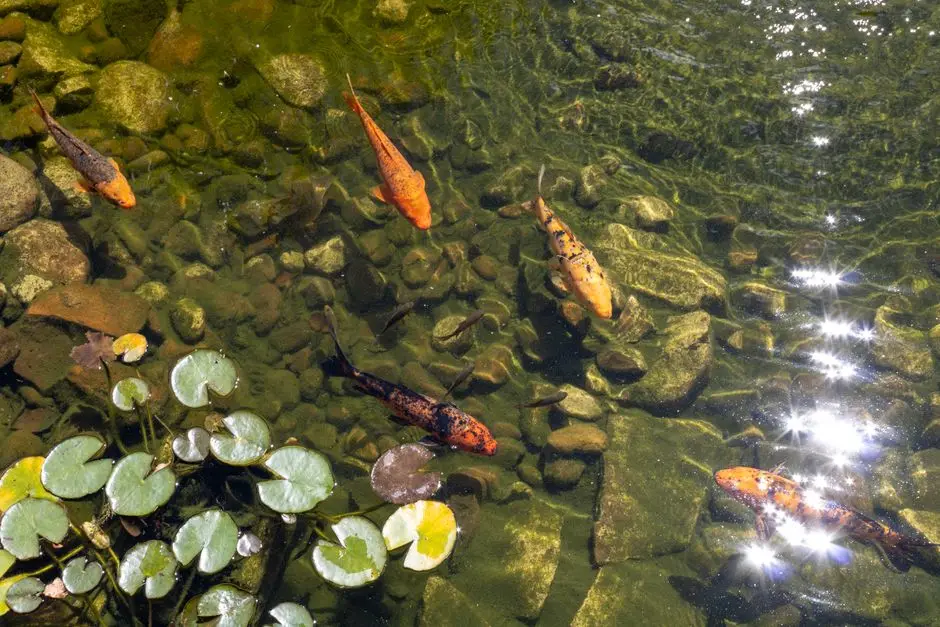
How a koi pond differs
Koi carp are large fish with high feed consumption and consequently high waste production. A plant zone would not sustain them, and the fish would also disturb it. Therefore, we build koi ponds as smooth tanks at least 1.5 metres deep, preferably 2 metres, with steep walls, a floor sloping towards bottom drains, and without gravel where sludge could accumulate. The liner is usually black or dark green to make the fish colours stand out.
Plants for koi ponds should be placed only in separate shallow areas or on floating islands where fish cannot reach them; their main function is to shade the water surface.
Filtration for fish ponds
We design filtration based on water volume, the number and size of fish, and feeding intensity. The rule is to circulate the entire volume approximately once per hour. The sequence is as follows:
- Bottom drains and skimmer They collect sludge from the bottom and impurities from the surface by gravity into the filter shaft.
- Mechanical stageA drum filter or mesh pre-filter captures solid particles and self-cleans.
- Biological stagechamber with a bacterial carrier (moving bed or Japanese mat) where ammonia from faeces is converted into nitrates.
- UV lamp At the outlet, floating algae that would turn the water green are destroyed.
- Pump and aeration. Energy-efficient pump with regulation and aeration that maintains oxygen levels in summer and under ice.
Undersized filtration is the most common reason a koi pond fails to function. A filter „for 20 m3" from a box assumes a few small fish, not ten koi measuring 50 cm each. That is why we ask about the stock before we start drawing plans.
Overwintering and operation
Koi overwinter at the bottom in depths exceeding 1.5 metres, where the water temperature remains stable around 4 degrees. During winter, filtration is either kept running on a reduced setting or switched off while aeration maintains an opening in the ice. In spring, once the water warms above 10 degrees, the filter is restarted and feeding of the fish begins. We can assist with seasonal adjustments or take them over as part of maintenance.
Filtration for existing garden ponds
Do you have a pond with fish and green water? Filtration can also be added later: a gravity system with a drum filter requires a shaft next to the pond, while a pumped pressure filter with UV can be hidden in a corner without excavation. We will assess the volume, stock and access and propose a solution that makes sense.